304 vs. 316 Stainless Steel Casters: What’s the Difference and Which Should You Choose?
When selecting industrial casters, wheel size, load capacity, and mounting style are often the first things customers consider. But in environments exposed to moisture, chemicals, and frequent cleaning, the type of stainless steel used in the caster can be just as important.
At Service Caster Corporation, we offer stainless steel caster solutions designed for a wide range of commercial and industrial applications.
Two of the most common stainless steel grades are 304 and 316. While both provide excellent corrosion resistance, understanding their differences can help you choose the right caster for your equipment.
What Makes 316 Stainless Steel Different?
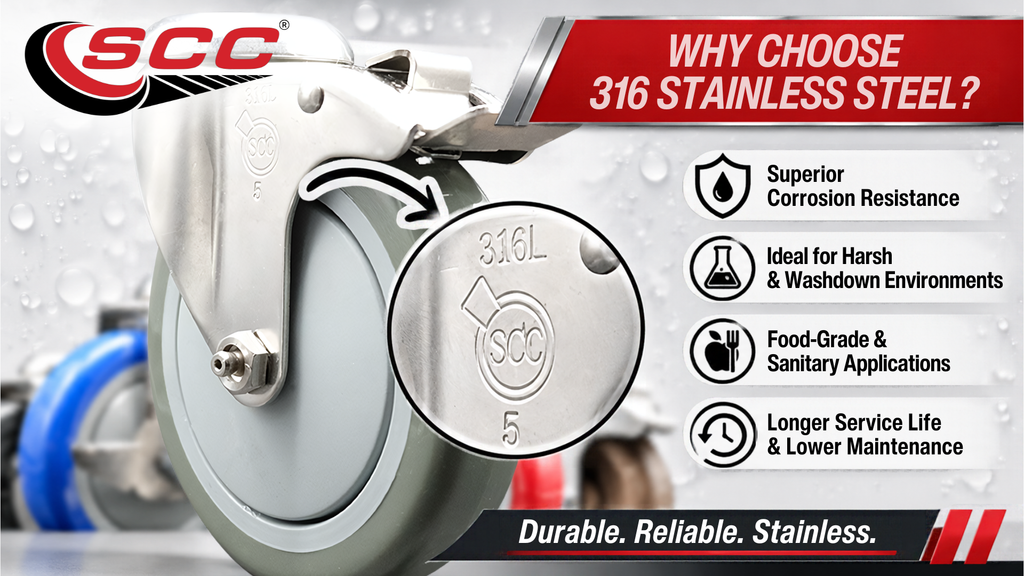
The primary difference between 304 and 316 stainless steel is the addition of molybdenum in 316 stainless steel.
This added element improves resistance to certain types of corrosion, particularly pitting and crevice corrosion caused by chlorides.
For applications involving salt exposure, frequent washdowns, or certain cleaning chemicals, 316 stainless steel may provide additional protection compared to standard 304 stainless steel.
304 vs. 316 Stainless Steel Casters: A Quick Comparison
General Corrosion Resistance
- 304 Stainless Steel: Excellent
- 316 Stainless Steel: Excellent
Salt and Chloride Resistance
- 304 Stainless Steel: Good
- 316 Stainless Steel: Superior
Frequent Washdowns
- 304 Stainless Steel: Suitable for many applications
- 316 Stainless Steel: Often preferred for more demanding conditions
Chemical Exposure
- 304 Stainless Steel: Suitable for many cleaning environments
- 316 Stainless Steel: Improved resistance to certain chemicals
Material Cost
- 304 Stainless Steel: More economical
- 316 Stainless Steel: Higher initial investment
Both grades have their advantages. The best choice depends on your equipment, operating conditions, and maintenance requirements.
Where Are 316 Stainless Steel Casters Commonly Used?
🏭 Food Processing and Commercial Kitchens
Food processing equipment is frequently exposed to water, cleaning solutions, and washdown procedures.
316 stainless steel casters can provide additional corrosion resistance for carts, racks, and mobile equipment operating in demanding cleaning environments.
💊 Pharmaceutical and Laboratory Equipment
Laboratories and pharmaceutical facilities often require equipment materials compatible with specific cleaning and sanitation procedures.
316 stainless steel casters can be a suitable option when additional corrosion resistance is needed.
💧 Washdown and Wet Environments
Industrial equipment exposed to repeated washdowns, moisture, and cleaning chemicals may benefit from 316 stainless steel construction.
Choosing the proper wheel material, bearings, and mounting hardware is equally important.
🌊 Marine and Coastal Environments
Saltwater and coastal conditions can accelerate corrosion on industrial equipment.
316 stainless steel offers improved resistance to chloride-related corrosion, making it a popular material choice for these applications.
Is 316 Stainless Steel Worth the Additional Cost?
For many general-purpose applications, 304 stainless steel casters provide excellent performance at a lower initial cost.
However, when equipment operates in more demanding conditions, upgrading to 316 stainless steel may help reduce corrosion-related maintenance and premature replacement.
Consider these factors before selecting your caster:
- Frequency of washdowns and cleaning
- Exposure to salt, moisture, or chemicals
- Required load capacity
- Wheel material and floor conditions
- Bearing and hardware compatibility
- Long-term maintenance requirements
The right caster isn’t always the least expensive option. It’s the one that best matches your application.
Choosing the Right Stainless Steel Caster Wheel
Selecting the correct stainless steel grade is only part of the process.
At Service Caster, we also recommend considering the wheel material and caster configuration.
Depending on the application, options may include:
- Polyurethane wheels for smooth rolling and floor protection
- Nylon wheels for certain wet and industrial environments
- Rubber wheels for quieter operation and cushioning
- Swivel casters for maneuverability
- Rigid casters for directional control
- Brake and locking options for equipment positioning
Always verify wheel material compatibility, load ratings, and environmental requirements before making your selection.
Shop Stainless Steel Casters at Service Caster
Whether you’re searching for 304 stainless steel casters, 316 stainless steel casters, washdown casters, or corrosion-resistant industrial caster wheels, Service Caster Corporation can help you find a solution that fits your equipment.
Our team can assist with wheel selection, mounting requirements, load capacities, and specialized applications.
Have questions about which stainless steel caster is right for you?
📞 Call Service Caster: 1-800-215-8220
🌐 Visit: www.servicecaster.com
Service Caster Corporation
Moving YOU Forward…