304 vs. 316 Stainless Steel Casters: What’s the Difference and Which Should You Choose?

304 vs. 316 Stainless Steel Casters: What’s the Difference and Which Should You Choose?

When selecting industrial casters, wheel size, load capacity, and mounting style are often the first things customers consider. But in environments exposed to moisture, chemicals, and frequent cleaning, the type of stainless steel used in the caster can be just as important.

At Service Caster Corporation, we offer stainless steel caster solutions designed for a wide range of commercial and industrial applications.

Two of the most common stainless steel grades are 304 and 316. While both provide excellent corrosion resistance, understanding their differences can help you choose the right caster for your equipment.

What Makes 316 Stainless Steel Different?

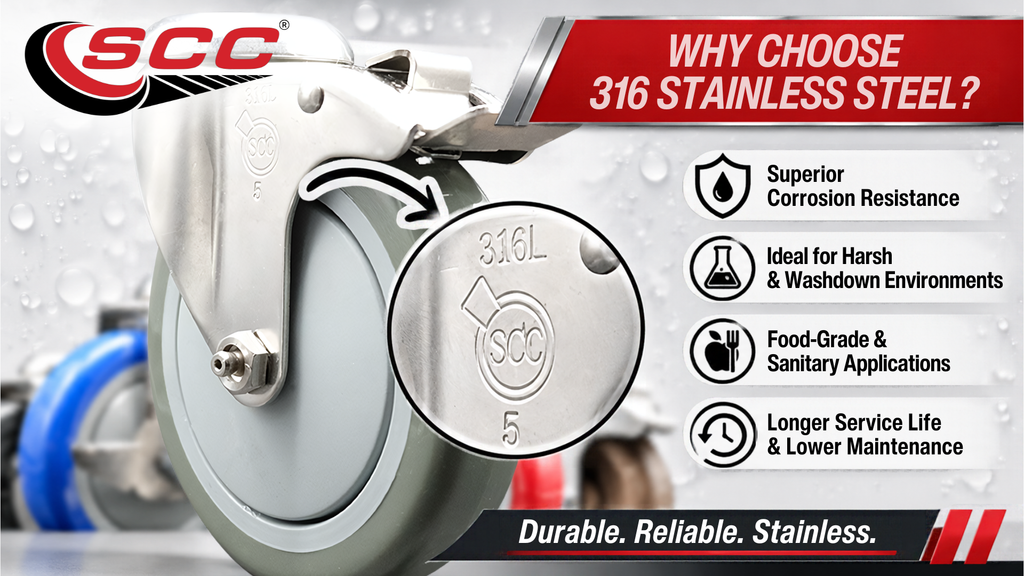
The primary difference between 304 and 316 stainless steel is the addition of molybdenum in 316 stainless steel.

This added element improves resistance to certain types of corrosion, particularly pitting and crevice corrosion caused by chlorides.

For applications involving salt exposure, frequent washdowns, or certain cleaning chemicals, 316 stainless steel may provide additional protection compared to standard 304 stainless steel.

304 vs. 316 Stainless Steel Casters: A Quick Comparison

General Corrosion Resistance

  • 304 Stainless Steel: Excellent
  • 316 Stainless Steel: Excellent

Salt and Chloride Resistance

  • 304 Stainless Steel: Good
  • 316 Stainless Steel: Superior

Frequent Washdowns

  • 304 Stainless Steel: Suitable for many applications
  • 316 Stainless Steel: Often preferred for more demanding conditions

Chemical Exposure

  • 304 Stainless Steel: Suitable for many cleaning environments
  • 316 Stainless Steel: Improved resistance to certain chemicals

Material Cost

  • 304 Stainless Steel: More economical
  • 316 Stainless Steel: Higher initial investment

Both grades have their advantages. The best choice depends on your equipment, operating conditions, and maintenance requirements.

Where Are 316 Stainless Steel Casters Commonly Used?

🏭 Food Processing and Commercial Kitchens

Food processing equipment is frequently exposed to water, cleaning solutions, and washdown procedures.

316 stainless steel casters can provide additional corrosion resistance for carts, racks, and mobile equipment operating in demanding cleaning environments.

💊 Pharmaceutical and Laboratory Equipment

Laboratories and pharmaceutical facilities often require equipment materials compatible with specific cleaning and sanitation procedures.

316 stainless steel casters can be a suitable option when additional corrosion resistance is needed.

💧 Washdown and Wet Environments

Industrial equipment exposed to repeated washdowns, moisture, and cleaning chemicals may benefit from 316 stainless steel construction.

Choosing the proper wheel material, bearings, and mounting hardware is equally important.

🌊 Marine and Coastal Environments

Saltwater and coastal conditions can accelerate corrosion on industrial equipment.

316 stainless steel offers improved resistance to chloride-related corrosion, making it a popular material choice for these applications.

Is 316 Stainless Steel Worth the Additional Cost?

For many general-purpose applications, 304 stainless steel casters provide excellent performance at a lower initial cost.

However, when equipment operates in more demanding conditions, upgrading to 316 stainless steel may help reduce corrosion-related maintenance and premature replacement.

Consider these factors before selecting your caster:

  • Frequency of washdowns and cleaning
  • Exposure to salt, moisture, or chemicals
  • Required load capacity
  • Wheel material and floor conditions
  • Bearing and hardware compatibility
  • Long-term maintenance requirements

The right caster isn’t always the least expensive option. It’s the one that best matches your application.

Choosing the Right Stainless Steel Caster Wheel

Selecting the correct stainless steel grade is only part of the process.

At Service Caster, we also recommend considering the wheel material and caster configuration.

Depending on the application, options may include:

  • Polyurethane wheels for smooth rolling and floor protection
  • Nylon wheels for certain wet and industrial environments
  • Rubber wheels for quieter operation and cushioning
  • Swivel casters for maneuverability
  • Rigid casters for directional control
  • Brake and locking options for equipment positioning

Always verify wheel material compatibility, load ratings, and environmental requirements before making your selection.

Shop Stainless Steel Casters at Service Caster

Whether you’re searching for 304 stainless steel casters, 316 stainless steel casters, washdown casters, or corrosion-resistant industrial caster wheels, Service Caster Corporation can help you find a solution that fits your equipment.

Our team can assist with wheel selection, mounting requirements, load capacities, and specialized applications.

Have questions about which stainless steel caster is right for you?

📞 Call Service Caster: 1-800-215-8220

🌐 Visit: www.servicecaster.com

Service Caster Corporation

Moving YOU Forward…

Forecasting and AI for Manufacturers

#USAMfgHour Twitter Chat Recap for May 21, 2020

businessman hand drawing virtual chart business on touch screen computer

On May 21, 2020, Tony Nash, the CEO and Founder of Complete Intelligence (@complete_intel), hosted a #USAMfgHour Twitter chat on forecasting and AI for manufacturers.  Below is a summary of Tony’s (@TonyNashonAsia) questions and answers on this very important topic.

Question 1:  What are some of the trends manufacturers can expect to see in 2020 and in the next few years? 

Answer 1a:  “Procurement and category leaders will increasingly become strategy players within their companies. With AI/ML tools for cost transparency & scenario planning for manufacturing, these leaders can show ROI, significantly improve margins” 

Answer 1b: “#Supplychains will become more regionalized over the coming years. #Manufacturers will need #AI #ML cost technology to quickly run scenarios on cost estimates, supplier comparison and risk assessments for each new #sourcing location”.

Question 2: Why choose an #AI solution for cost control in #manufacturing? 

Answer 2:  “Non-AI forecasting methods are limiting. As companies are reforecasting, decision cycle time is critical. AI/ML models compute millions of calculations to optimize cost outlooks. Better information & forecasts = more informed clients = better decisions”

Question 3:  Did you know the average consensus forecast error is double digits? Do you know the accuracy of the forecasts you are using?

Answer 3:  “We regularly test our #AI #ML forecast accuracy compared to consensus forecast. Our core belief is that data & math should drive the forecast results without human intervention or bias. What we found was astonishing. CI outperformed consensus 88% of the time.”

Question 4:  If enterprise BOM materials aren’t publicly traded commodities, can these material costs be forecasted accurately? 

Answer 4:  “Yes! One of the challenges we see for product lines is that consensus forecasts & indexes lack context and detail for specific products, components, and raw materials. Our #AI #ML platform incorporates enterprise & market factors for specific cost & revenue items.”

Question 5:  Should my company build an #AI #ML cost analysis model in-house or outsource? 

Answer 5:  “Consider the budget, time to results, and expected outcomes. Looking for value and access to results quickly? Look to outsource those #AI #ML projects. Commercialized AI applications like @complete_intel’s CI Futures & CostFlow have a track record & proven success.” 

Visit Complete Intelligence to learn more about its #AI and #MachineLearning platform that gives highly accurate revenue and cost #forecasts

The #USAMfgHour chat is founded by @CVTPlastics @DCSCInc @witzshared and @SERVICECASTER.  Be sure to follow the official account for chat highlights, recaps, and information at @USAMfgHourChat and visit us on other platforms to keep in touch between chats.

LinkedIn Page

LinkedIn Group

Instagram

Generating Sales and Building Relationships in Manufacturing

Lead Generation Interest Marketing Business Concept

USAMfgHour Twitter Chat Recap for February 20, 2020

This week, Dan Bigger of CVT Plastics (@CVTPlastics) hosted a #USAMfgHour chat all about sales and relationship building.

After introductions by the participants that included what they do and what industries they primarily sell to, Dan started off the chat by asking what CRM, or customer relationship management systems, they use and what their recommended follow-up time frames are. Act! 365, Salesforce, Pipedrive, Zoho, Microsoft Dynamics 365, and Streak were some of the ones mentioned by participants as helping to track their leads. All the participants had different follow-up procedures. Some reach out fairly consistently while others follow predetermined schedules such as weekly, monthly, or quarterly based on whether the lead is “hot” or “cold”. But @AxisNJ’s comment that, “…it is key to keep in touch continuously even if a project is set to move later on,” summed up the topic nicely.

Next, Dan asked participants to name their best lead sources. Word-of-mouth recommendations and referrals from their networks were, by far, the most popular lead generators. Others included inside and outside salespeople, trade shows, social media, email marketing, SEO, website contact forms, targeted direct mail, data-driven lists, and PPC advertising. @NJMEP stressed the importance of generating leads from various sources so as not to put all your eggs in one basket and @GraphicProducts mentioned it often generates leads by sharing product knowledge for free to new connections.

Dan followed that question by asking how participants develop their leads in hopes of turning them into customers. @GetProdio said, “We regularly improve our product based on customers insight, suggestions, ideas. We are for them, not just to make profit. We are in regular touch (chat, mails, phone calls, social media, visits in person). It’s for us more than just B2B, rather H2H (human to human).” Other participants stated calls, emails, in-person visits, and facility tours as ways to gain trust of potential customers when they’re looking to bid a project or buy a product. @Amatrol stated “Really, we want current and potential customers to see they’re getting the most robust service possible in our market,” so its development activities reflect that goal. Dan added that he developed a survey that enables customers to state when they want to be contacted and in what ways and allows the company to collect testimonials, referrals, and gain insights.

Dan closed the chat by asking the participants to share their 2020 sales goals. Not surprisingly, everyone stated their desire to add new clients to the roster this year. Other goals included expanding into new markets, increasing brand awareness, utilizing digital or traditional advertising, continuing existing marketing efforts and maintaining high levels of customer service to existing customers in order to encourage repeat or referral business.
On February 27, 2020, Joanna Johnston of Estes Group (@EstesGroup) will be leading a chat on ERP and manufacturing IT security. Will you be joining us? The #USAMfgHour chat is founded by @DCSCInc @BIllGarlandSpkr @CVTPlastics @witzshared and @SERVICECASTER. Be sure to follow the official account for chat highlights, recaps, and information at @USAMfgHourChat and visit us on other platforms to keep in touch between chats.

LinkedIn Page: https://www.linkedin.com/company/usamfghour-twitter-chat/
LinkedIn Group: https://www.linkedin.com/groups/12334688/
Instagram: @usamfghourchat

Tags: @DCSCInc @BIllGarlandSpkr @witzshared @SERVICECASTER @AxisNJ @CVTPlastics @NJMEP @GraphicProducts @GetProdio @IndeeLiftInc @Amatrol @dpistulka @specialtaps @socialsmktg @WMPaintingInc_ @EstesGroup @LiftWisco @NesbitMarketing @envmfilter @SpaceGuard @ProTapes @Solution_System

Caster and Wheel Bearings

A confusing term at times can be bearings in regards to their use in casters. Bearings are used in casters for both wheels and swivel heads, and here we will discuss both.

Wheel Bearings

Wheel bearings sit between the wheel and axle, and provide a way for the wheel to easily spin on the axle. These bearings come in a number of different types, each with its own advantages.

Delrin bearings are inexpensive, and need no maintenance. They are a simple bushing made of Delrin, a plastic material. Delrin bearings work well in wet applications since they have no moving or metal parts that could corrode.

Roller bearings are best suited to low speed, manual operation with intermittent use. The roller bearing consists of a series of rollers arranged to sit on an axle and easily roll around it. Roller bearings can be solid or split caged. Split cage roller bearings do not handle side thrust as well as their solid counterpart, which is inserted into the wheel with a press. Roller bearings require regular maintenance.

Precision Bearings are a high quality ball bearing. These are excellent for applications that require high speed, quiet, and/or continuous operation. Precision bearings do not require regular maintenance to function properly. Semi-Precision bearings offer a less expensive, low speed and light duty option for those that still want quiet, maintenance free operation.

Tapered bearings are used on the heaviest duty casters. These bearings can handle high speeds and power driven application. Tapered bearings also handle side thrust well, and excel at continuous operation. They do require regular maintenance for good performance.

Swivel Head Bearings

Swivel Head bearings are typically ball bearings inside of a raceway. The swivel head assembly and its bearings allow for the wheel to easily turn and add steerability to applications. This raceway can be sealed or exposed. A sealed raceway protects the bearing assembly from dirt and other debris that is harmful to the bearing. The raceway can also be precision made and hardened to increase the longevity and performance of the swivel head.

Please visit our caster wheel bearings page for additional information.

Flanged Wheels for Controlled Workflow

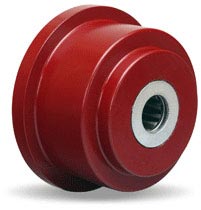
The flanged caster wheel is perfect for any situation requiring the use of a track. The flange (whether dual or single) keeps the wheel from jumping off the track during use.

Flanged wheels set themselves apart from other wheels by having a lip around one or both outside edges of the wheel. Most people will be familiar with flanged wheels as those on trains or old mining carts, however they are popular for many industrial and factory setting applications.

The use of a track with a flanged wheel can provide several advantages over a standard wheel rolling on the floor. The floor itself will see less wheel wear, and the caster unit and wheel will have less chance to pick up debris on the floor. Flanged wheels also provide tracked workflow to maintain controlled mobility as well as providing the ability to easily raise or lower the work.

Another distinct advantage is the ability of the flanged caster to bring the work overhead. A good example of this is on cranes and hoists that use flanged wheels to roll on an I-beam.

Check out our flanged wheel page for more information!

Choosing a Hardwood Floor Furniture Caster

You have a beautiful hardwood floor, but your chairs, tables, and other furniture on casters are all hard plastic and nylon. These hard material wheels will cut and scratch the floor easily. What solutions are there, you might ask?

Hardwood floor casters are available for any common connections types out there. These casters are made of soft polyurethane, rubber, or other materials specifically designed for hardwood floors. In most of these cases, the casters will not only be hardwood safe, but they will also roll and perform better. Materials that have more grip will roll easier than harder wheels, so you won’t skip or skid across the floor but instead roll smoothly.

Is a caster hardwood floor safe just because it’s rubber or soft material? No! A small diameter rubber wheel can cause as much damage as a hard wheel. When choosing a caster, get one that distributes weight over a wider area. Twin wheel casters are a good idea, or a large soft single wheel caster.

The investment of some quality hardwood floor casters greatly outweighs the cost of replacing or fixing a hardwood floor.

Toolbox Casters

One of our most popular products is our sets toolbox casters.  Customers in many industries, from DIY and “garage shop” users to mechanics and other technicians, have found our toolbox casters especially useful for their light and medium duty toolboxes, as the polyurethane wheels will not develop flat spots from periods of inactivity.

The wheels roll smoothly with integrated ball bearing design. And the polyurethane wheel will not mark or mar floors, performing well on most surfaces and excelling on hard surfaces like concrete, tile, and wood. 

Alternate uses for these wheels also include material handling, carts, equipment, and shop projects. 

Ready to order some for yourself?  Call 800-215-8220 or order online.

What kind of grease should I grease my casters with?

This is a pretty popular question posted to our customer service team at Service Caster and, unfortunately, we don’t have a simple answer for it.

All caster bearings need to be lubricated with a high-quality multi-purpose grease. The grease should have good extreme pressure, anti-wear characteristics, and should be able to withstand the temperature range that fits the application requirements.

Everyone uses their casters and wheels differently, so some may be required to grease their casters and wheels more often than others. Wheel and swivel bearings last longer if they are regularly lubricated. We recommend applying grease to friction points on the wheel hub, washer, and leg surfaces. This will reduce drag and improve rollability. Normal conditions may require lubrication every six months where extreme conditions may require lubrication monthly.  Extreme conditions include corrosive or exceptionally dirty environments. Finally, if the application experiences wash downs, lubrication may be needed after each wash. 

Using the correct grease for your casters and wheels is vital to their lifespan and performance.   Have questions? Give us a call at 1-800-215-8220 and we’ll help you out.

Three Tips to Make Lawn Maintenance a Breeze

It’s summer.  The grass is growing.  And growing. And growing.  It grows so fast that you barely have time to enjoy the fruits of your lawn mowing labor before you’re back at it again.  And that cute little flowerbed you planted in the spring? Well, now it’s a bed of weeds interspersed with flowers.  

Lawn care is serious business.  And, apparently, also a competitive one. Who hasn’t looked over at their neighbor’s lawn and gotten a case of comparisonitis?  When your lawn looks better, there’s an added swag to your step. When it looks worse, well, you make a beeline to wherever you store your lawnmower and fire it up.  

But these three tips can help make lawn maintenance a little easier on you.  Of course, all our tips involve the use of wheels. But, hey, we’re a caster company, so some shameless self stealth promotion is to be expected.

Hack Your Weed Wacker

A few weeks ago we had an elderly customer call into us to order wheels for his weed wacker.  It seems that due to some physical issues, he was no longer able to hold it up for long periods of time.  So, he thought, “Why not put some wheels on it?” Then he could push it around like a lawnmower. Pretty cool, huh? 

Make Your Garden Tools Mobile

So, that flowerbed we mentioned that’s overgrown with weeds?  Well, you probably won’t want to use a weed wacker on that because the flowers you so painstakingly planted will become collateral damage.  And you definitely don’t want to use one on that garden you planted lest your hard work cultivating those fruits and veggies will be for naught.  We can’t make pulling the weeds by hand any less painless for your lower back, but sharing our hack for keeping your tools close at hand will at least make the process a little easier and save you the inconvenience of having to travel to the shed or garage for the one garden tool you need at that moment.

Use a Utility Cart

Utility carts and wagons are great for hauling away those freshly-pulled weeds to your trash can or another area of the yard.  Coincidentally, they’re also useful for transporting the flowers from your car to the flowerbed in the first place. (Got kids toys strewn all over the yard?  You can go through the yard, pick them up, and put them in the cart instead of running them back to your toy storage one by one.)

Check out our Pinterest board for visuals of each one of our tips and then let us know which one you think will be most useful for you.  

Need some wheels?  Give us a call at 800-215-8220 and we’ll hook you up.